Art, memory, and immortality
Station ElevenArt, memory, and immortality form a central thread linking the novel’s vanished technological world to the culture built after the Collapse. When screens and networks fail, what remains is not a single permanent record but a shifting inheritance: actors’ performances, old pages, comics, remembered faces, and objects handled by people who were not there when they were made. Art cannot restore the lost world, but it can make that world present to others—and turn remembrance into a shared practice.
Being seen, then remembered
A passage from a philanthropist’s ghostwritten memoir distinguishes public virtue from the ambitions that first draw people into entertainment. Actors may later use celebrity to support charitable causes, but the passage observes that many entered the industry because they loved acting and wanted recognition. Its account of fame then turns toward a longer desire: “First we only want to be seen, but once we’re seen, that’s not enough anymore. After that, we want to be remembered.” The formulation gives artistic work two linked horizons: the immediate encounter with an audience and the possibility that a performance or face will outlast its maker.
The memoir makes that possibility concrete through old films. Their actors are long dead, yet the image preserves not only famous performers but also bit players: a maid with a tray, a butler, a cowboy in a bar, or a girl in a nightclub scene. In the writer’s account, their continued visibility is a kind of immortality. The claim does not depend on fame alone; even a fleeting presence in a film can remain available to a later viewer. After the Collapse, however, such survival is precarious. A sentence in Frank’s manuscript raises the question of whether the thought about immortality belongs to Frank or to the philanthropist whose book he is writing. Jeevan cannot determine its authorship. He folds the page and keeps it, so the uncertain line survives as both a piece of writing and a trace of the person who handled it.
Screens go dark; connection changes form
The novel measures the loss of the old world through the disappearance of its communications. The Internet had carried photographs, pleas for help, complaints, plans, and small updates from other people’s lives; its ordinary traffic offered a feeling of being less alone. During the collapse, broadcasts dwindle to emergency messages, static, and test patterns. The final camera in an empty newsroom is switched off or dies, and the Internet goes dark soon afterward. A technology once experienced as an invisible connection becomes an absence that the survivors must explain.
That loss persists in the younger generation’s fascination with screens. In Traverse City, an inventor pedals a stationary bicycle to power a laptop while trying to find the Internet. The screen displays “This webpage is not available,” yet the attempt stirs the younger members of the Travelling Symphony: the vanished network remains imaginable as something still suspended beyond reach. Kirsten is fascinated less by remembered computer use than by electricity itself, picturing lamps, a nightlight, a chandelier, and a brightly lit stage. Alexandra experiences the screen as magical because she has no memory attached to it; August looks at it with a lost expression. The same device therefore holds different pasts: an object of wonder, a faint recollection, or a reminder of what has disappeared.
August’s attachment to television gives that difference a personal history. As a child in interchangeable Army-base houses, he was often alone after school, watching the same programs that appeared wherever his family was posted. In the present, he searches abandoned houses for old TV Guide issues and reads them later, using their listings to recall starships, sitcom rooms, police officers, and courtrooms. The schedules preserve the shape of a vanished medium even when they cannot bring its programs back. In the airport school, meanwhile, children learn about airplanes, electronic devices, satellites, and a worldwide network they have never experienced. They can locate places such as Severn City on a map, but the old borders and the idea of a network transcending them remain difficult to grasp. Knowledge survives, but its meaning changes when direct experience is gone.
Performance makes the past present
The Travelling Symphony’s performance of A Midsummer Night’s Dream stages the tension between loss and renewal in a parking lot at St. Deborah by the Water. Lake Michigan lies nearby; candles light the altered world, and Kirsten plays Titania with a crown of flowers in her close-cropped hair. Her wedding dress, scavenged near New Petoskey, bears blue streaks from a child’s watercolour kit. Sayid, wearing a tuxedo found in a dead man’s closet, circles her as Oberon. The performance is assembled from salvaged things, but onstage those things become costume, character, and occasion.
The play’s history echoes the performers’ circumstances. Kirsten speaks lines about contagious fogs and disturbed seasons from a work written around the time London’s theatres reopened after plague closures. The text’s note on the word “contagious” leads into the play’s own record of death: Shakespeare’s siblings who died young and his son Hamnet, who died at eleven. The staging does not make the historical plague identical to the novel’s catastrophe; instead, it lets an older work of art carry the fact that theatres and human communities have endured repeated encounters with death. In candlelight, with electricity gone, Kirsten’s voice and the waiting musicians restore the lines to a living audience.
For Kirsten, performance is also a bodily change of state. Onstage she feels alive and fears nothing; after the play, she remains suspended, as if she has flown high and not fully landed. The audience’s silence, tears, and standing ovation register the event as more than the delivery of a preserved text. The performance exists in the shared moment between actors and listeners, then passes into memory. The Travelling Symphony’s lead caravan carries the words “Because survival is insufficient,” making its artistic purpose visible alongside its name. The phrase distinguishes keeping people alive from sustaining forms of experience, attention, and feeling.
Archives, recollection, and inheritance
In the years after the Collapse, art and memory circulate through improvised institutions as well as performances. At Severn City Airport, the school teaches children what the Internet and air travel once meant, while the Museum of Civilization preserves phones, newspapers, and other remnants for visitors who come after work. These objects are not simply useful or obsolete: they prompt questions, recollections, and acts of attention. James returns to look at the motorcycle he once rode; Emmanuelle, the first child born at the airport, comes to see the phones. The museum turns looking into a recurring communal practice.
A newspaper from New Petoskey offers a different kind of record. Its three consecutive issues carry local births, deaths, weddings, barter notices, warnings, and news of the Travelling Symphony. One includes a rapturous account of a King Lear performance starring Gil Harris and Kirsten Raymonde. François Diallo, the newspaper’s publisher and the town librarian, fills spare space with a poem by Emily Dickinson or an excerpt from a biography of Abraham Lincoln. The newspaper holds immediate local life beside older writing, making cultural inheritance part of an irregular record of current events. Its interview with Kirsten also reveals the limits of personal memory: she knows she left Toronto with her brother because he told her, while her own recollection of the time is restricted to a particular night.
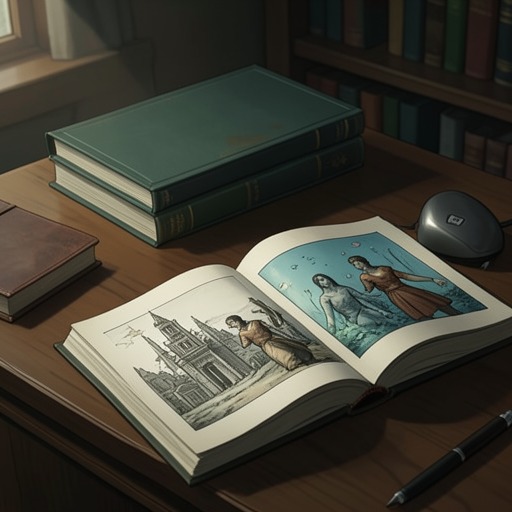
The novel brings preservation and recollection together in Clark Thompson’s response to a Dr. Eleven comic. Before leaving the airport, Kirsten gives Clark one of her two copies so that at least one will remain safe if the Travelling Symphony encounters trouble. Later, Clark reads it by candlelight in the Museum of Civilization and recognizes a dinner party on the page as one he attended in Los Angeles before the Collapse. Elizabeth Colton appears in the comic, and the man in the shadows resembles Arthur Leander; Miranda is absent from the drawn gathering, her place taken by Dr. Eleven. The image does not reproduce Clark’s past exactly. It rearranges it, while prompting his memory to supply the people and details the comic leaves out. His recollection brings Miranda back to mind and recovers his curiosity about her, alongside his affection for the guests, hosts, and caterers. Art becomes a meeting point between a preserved image and a memory that had lain dormant.
The afterlife of art
These episodes give artistic survival several distinct forms. Film preserves faces; a handwritten page carries an uncertain author’s thought; a play renews old language through particular bodies and a particular audience; a newspaper places local news beside inherited literature; a comic can call an entire evening back to someone who was there. None offers complete recovery. Memory is partial, artifacts can be misread, and the people who encounter them bring different histories. Yet their incompleteness is also what makes interpretation and transmission necessary.
The novel’s account of immortality is therefore less a promise that individuals escape death than an account of how traces move between people. The old network once connected strangers through messages and images; after its disappearance, connection depends on performances, conversations, books, and objects passed from hand to hand. The Travelling Symphony’s work, Clark’s museum, and the surviving printed records all make remembrance active rather than automatic. Art does not reverse the Collapse. It lets the past be encountered again, changed by the present, and carried onward.